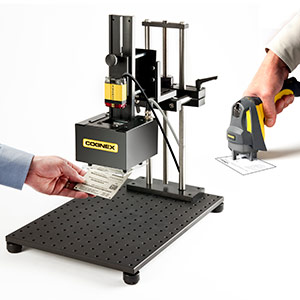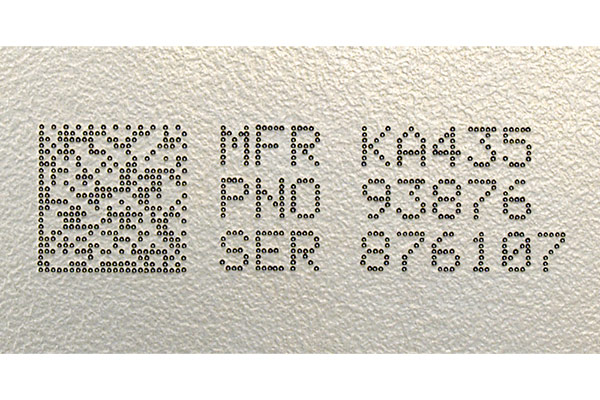
Machine-readable identification holds the key to manufacturing efficiency.
Machine-readable identification is used to automatically identify a variety of products. Manufacturers are marking parts with machine-readable, permanent two-dimensional (2D) Data Matrix codes that are placed directly on the part itself. Then the part can be tracked throughout its entire life cycle, including manufacturing and supply chain operations. This is called Direct Part Mark Identification (DPMI), or Auto-ID. Established industry DPMI specifications and 2D marking guidelines are listed in the table below.
DPMI enables many tangible benefits for manufacturers. This practice:
- Improves manufacturing process performance
- Identifies quality defects through in-service tracking
- Eliminates manual part data entry errors
- Supports data logging and automated data collection
- Increase yields, and
- As a result, reduces the direct and indirect costs of manufacturing.
Many manufacturers rely on Auto-ID as well to track high-value parts to prevent theft or counterfeiting, identify parts for maintenance and returns, and to resolve warranty issues and liability claims.
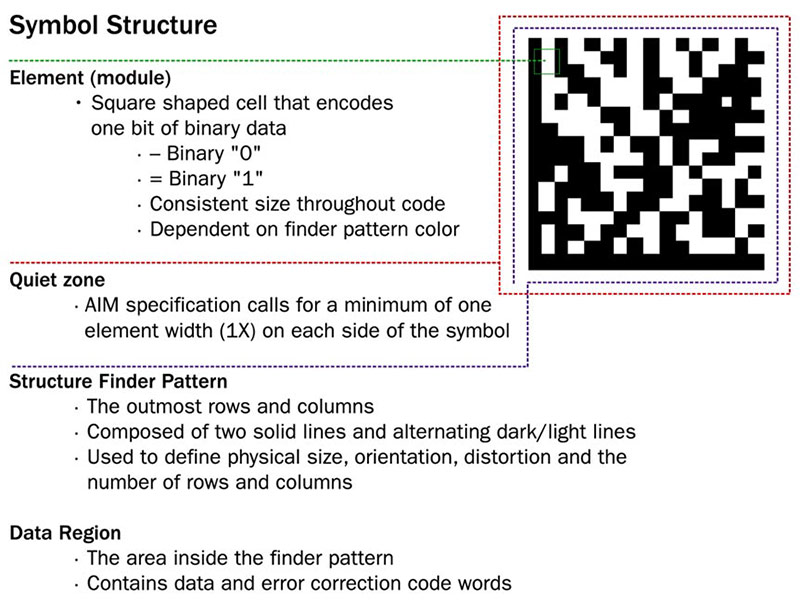
The two-dimensional 2D Data Matrix code consists of an arrangement of small dots or squares, marked as either a square or rectangle. Invented by RVSI Acuity CiMatrix, the Data Matrix Code is a digital 2D, machine-readable symbology that is capable of storing large amounts of information within a small physical space. This code has been adopted by many industries, including aerospace, automotive, and electronic, as the best symbology for reliable, direct part marking. Compared to linear barcodes, Data Matrix encodes much more data – 25 to 100 times more information – into a smaller area, allowing code placement on a wide range of product configurations. Data Matrix requires less contrast (as low as 20%) between the code and the marking surface than linear barcodes. This allows the code to be marked on difficult surfaces of metal, non-metallic, and plastic components. Built-in error correction allows the encoded information to be captured even if the Data Matrix symbol is somewhat degraded.
Dapra Marking Systems offers a wide variety of marking systems to encode 2D symbols directly on parts. These include dot peen and laser marking systems. We also supply both fixed-station and hand-held Data Matrix readers and verifiers from Cognex.